Ocean Breeze Visitors Around The Globe

Free counters!
Showing posts with label Western Visayas. Show all posts

Wednesday, March 11, 2026

Western Visayas Dishes: Suman Ambalong / Suman sa Ukaw (Aklan)


Suman nga Amboeong (Hiligaynon: Suman Ambalong) (also widely known in Aklan as Suman sa Ukaw) is a highly treasured, traditional Aklanon delicacy. Unlike the typical Filipino suman made from glutinous rice or cassava, this unique version features a distinct, gelatinous texture and an earthy sweetness that makes it stand out in the world of native kakanin (rice cakes).


💡 Facts & Trivia

  • The Mystery of "Amboeong" / "Ukaw": Amboeong (pronounced with the distinct Aklanon rolling 'l' or 'w' sound) refers to the native sago palm (Metroxylon sagu). Ukaw is the local term for the raw starch extracted from the inner trunk of this palm tree. Once processed and dried, it turns into a fine, starchy flour.

  • The Secret is in the "Gawod": Traditional recipes heavily feature gawod, which is finely grated young coconut meat. The tender, juicy crunch of the young coconut provides a beautiful textural contrast to the smooth, chewy gelatinous structure of the ambolong starch.

  • A Festive Native Staple: While historically a food born out of utilizing local forest resources, Suman nga Amboeong has evolved into a celebration food. It is proudly prepared by Aklanon families during Christmas, town fiestas, and milestone birthdays.


🍳 How to Cook Suman nga Amboeong

To make this authentic treat, you will need to source ambolong (ukaw) flour, which can usually be found in public markets across Aklan or specialty visual markets in Western Visayas.


Ingredients

  • 1 cup Ambolong flour (Ukaw)

  • 2 cups Grated young coconut (Gawod)

  • 1 cup Muscovado sugar (Mascobado or dark brown sugar)

  • 1 tbsp Vanilla extract (optional, for aroma)

  • Wilted banana leaves (for wrapping)


Preparation & Cooking Steps

1.Prep the Banana Leaves:5 mins.

Wipe your fresh banana leaves clean with a damp cloth. Pass them quickly over an open flame for 3 to 5 seconds. This softens ("wilts") the leaves, making them pliable so they won't tear when you wrap the suman. Cut into 6x8 inch rectangles.

2.Mix the Base Ingredients:5 mins.

In a large mixing bowl, combine the 1 cup of ambolong flour, 2 cups of grated young coconut (gawod), and 1 cup of muscovado sugar. Add the vanilla extract if using.

3.Blend Until Fully Incorporated:5 mins.

Stir and fold the mixture vigorously using a sturdy spoon. Ensure the sugar is well distributed and the coconut juices slightly hydrate the starch. The mixture will look like a thick, grainy paste.

4.Wrap the Suman:10 mins.

Scoop about 2 tablespoons of the mixture and place it onto the center of a prepared banana leaf. Roll and shape it into a neat log (about 4 to 5 inches long). Fold both ends of the leaf tightly inward to completely seal the mixture.

5.Steam to Perfection:35-45 mins.

Arrange the wrapped logs horizontally in a steamer. Steam over medium-high heat for 35 to 45 minutes. You'll know it's ready when the leaves darken significantly and the suman inside feels firm and springy to the touch.

Pro-Tip: Let the suman cool down for at least 15 to 20 minutes before unwrapping! Because ambolong starch is highly gelatinous when hot, letting it cool allows it to set into its perfectly chewy, signature texture. Enjoy it alongside a hot cup of native black coffee or tsolate (hot cacao drink).


The extraction of ambolong or ukaw starch from the sago palm is a meticulous, labor-intensive craft that has been passed down through generations of Aklanons. Because the starch is stored entirely inside the core of the tree trunk rather than in seeds or roots, getting it out requires a physical, water-heavy separation process.


The traditional extraction method breaks down into these fundamental steps:

1. Felling and Sectioning

The process begins with finding a mature sago palm that is just about to flower—this is the exact moment when the starch content inside the trunk is at its absolute peak. Once the tree is cut down, the long trunk is sawed horizontally into manageable logs or sections, usually about 1 meter long each.

2. Splitting and Scraping (Pag-isnak or Grating)

The tough, bark-like outer layer of each log is split open lengthwise to expose the soft, fibrous inner pith. Historically, local processors use a specialized wooden tool or an adze-like scraper to manually grate and shred the pith into a very fine, coarse pulp. This aggressive grating breaks down the plant cells, freeing the tiny starch granules trapped within the fibers.

3. Washing and Kneading

The shredded pulp is then transferred to a large, elevated washing setup. Traditionally, this consists of a woven mat or a fine-mesh cloth suspended over a large trough. Water is poured continuously over the pulp while the extractor vigorously squeezes and kneads it by hand. The water acts as a carrier, flushing the loose starch out of the fibers and washing it through the cloth, while the coarse woody residue (called hampas) is left behind.

4. Settling and Decanting

The milky water running off the pulp drains into a settling container below. It is left completely undisturbed for several hours. Because the pure starch granules are heavier than water, they gradually sink, forming a thick, dense paste layer at the very bottom of the trough. Once the separation is complete, the clear surface water is carefully tilted and drained off (decanted).

5. Sun-Drying and Milling

The remaining wet starch is scooped out in thick chunks. To transform it into the final product, these chunks are crumbled and spread out evenly on wide mats under the hot sun to dry completely. Once dry, the white-to-light-grey blocks are finely crushed and sifted into a silky, powdery flour.

🌾 The "Whispered Prayer" Custom: In Aklanon tradition, making Suman sa Ukaw is deeply tied to old beliefs. Local harvesters often whisper a quiet prayer before gathering the ingredients or cutting down the palm. It is traditionally believed that if the extractors are in a negative mood or fail to show respect to the tree, the starch will yield poorly or fail to form the perfect gelatinous texture when cooked. 


The traditional extraction of ambolong (sago) starch is a labor-intensive process defined by the physical separation of starch granules from the fibrous pith of the Metroxylon sagu palm. The methodology typically follows a standard sequence of disintegration, washing, and sedimentation (Bagasbas & Barroca, 2020; Kamal, 2007).


The instructions, facts, and trivia provided for Suman nga Amboeong (Suman sa Ukaw) come from local cultural knowledge, regional culinary traditions, and oral histories passed down in Aklan rather than documented scientific papers or academic journal articles.

Because it is an indigenous heritage dish unique to Western Visayas, specific recipes and the traditional knowledge of extracting ukaw (sago palm starch) are preserved by local community cooks and families rather than indexed in formal databases.

If you're researching this further or looking to purchase the ingredients, you will generally find references to it in:

  • Local cultural tourism and culinary maps published by the province of Aklan.

  • Regional cooking heritage documentations (such as food blogs and documentation by West Visayan food historians).

  • Public markets in Kalibo and neighboring towns, where the raw ukaw starch is sold by local vendors who pass down the preparation instructions verbally.


References

Bagasbas, J. M., & Barroca, R. B. (2020). Development and evaluation of sago (Metroxylon sagu) pith extractor. Journal of Agricultural Engineering, 51(3), 140–147. https://doi.org/10.4081/jae.2020.1058 Cited by: 8

Flach, M. (1997). Sago palm, Metroxylon sagu Rottb. International Plant Genetic Resources Institute. Cited by: 282

Kamal, S. M. M. (2007). Improvement on sago flour processing system using “Auto Squeezer”. International Journal of Engineering and Technology, 10(2). Cited by: 40


UKAW 😋❤️ What is the name of this delicacy in your province?


The main ingredient in making Ukaw comes from the crushed ambulong tree.


It needs to be crushed so that it is not difficult to squeeze.


Women and young people often join in the weaving. The leaves of the cut ambulong tree are used to make thatch.


The collected crushed ambolong tree is squeezed in water to extract its juice.


The dried juice of the ambulong is called Natok or Sagu.


The ambulong sap will flow through the split bamboo. After a few minutes, the Natok will naturally descend and separate from the water.


Once the water has been discarded, the accumulated natok or sago is then collected.


It is thick and has a texture similar to ice cream.


The natok will be mixed with gawod (old coconut) and sugar.


Ibabalot ito sa dahon at saka pakukuluan


After boiling for a few minutes, there is a delicious snack, UKAW ❤️


The uncooked natok will be left out in the sun to dry.


Wet natok cannot be stored for long periods of time because it will smell and spoil quickly.


Meanwhile, dried natok or sago lasts for several months when stored. It can also be used as a thickener in bilo-bilo or made into sago pearls.


Source:

Angelo Cortes. (2024, June 17). Alam niyo ba ang proseso sa paggawa ng suman na ukaw sa Aklan… Ang Paggawa ng Suman na Ukaw or Suman Ambalong. Facebook. 


Monday, February 9, 2026

Philippine Mythological Creature: Bawa (Antique)


Supernatural beings known as the Bawa have lips that hang so widely that they conceal their faces. They can appear as a chicken and use the sound of a cackling to announce their presence. Additionally, they have the ability to change into a dog, pig, cow, or stone. If left alone, the Bawa are said to be harmless. However, they have the ability to wring a man's or carabao's neck, which makes them extremely vicious once injured.

The Bawa (or Baua) is a mythical, bird-like creature from Western Visayas (specifically Kinaray-a mythology in Antique) that lives in a sky cave called Calulundan, guarded by blue smoke. It causes eclipses by swallowing the moon when food is scarce, typically two or three times a year. 


Key Details about the Bawa:

Behavior: It is described as a giant bird.

Eclipse Belief: When the Bawa eats the moon, it causes a lunar eclipse.

Defense: People traditionally played music or made noise to force the creature to release the moon.

Distinction: It is distinct from the Bakunawa, which is a sea-serpent dragon, though both are associated with consuming the moon in Philippine folklore. 


It is not to be confused with the Popobawa, a shapeshifting, bat-like demon from Zanzibar. 


Sources:

"Bawa Philippine Mythological Creature Art". Reddit. May 15, 2021. Retrieved February 9, 2026.

"Philippine Creature : BAWA – (Antique)". Youtube. May 31, 2025. Retrieved February 9, 2026.

Tuesday, October 28, 2025

Philippine Mythological Creature: Aswang

The best way to understand the aswang concept is as a collection of beliefs about five different types of mythical creatures that are associated with specific creatures from European tradition: (1) the vampire, (2) the self-segmenting viscera sucker, (3) the weredog, (4) the vindictive or evil-eye witch, and (5) the ghoul that eats carrion. Therefore, the physical characteristics, habitat, or actions of these five categories of mythological beings—and occasionally other mythical beings like the demon, dwarf, and elf—are typically referred to when Philippine folklore speaks of the aswang.  Here is a quick explanation of each facet of the aswang, a term mostly used by the nation's Tagalog, Bikol, and Visayan communities.


(Blood Sucker Aspect: Bicol, Cebu, Visayas, Ilokano) According to Philippine folklore, a vampire is a bloodsucking entity that poses as a lovely girl. By marrying an innocent young man, it is able to drink a small amount of his blood every night until he passes away from anemia, at which point the monster finds a new husband. The vampire punctures the jugular vein with the tip of its tongue, which is pointed like a mosquito's proboscis, in order to draw blood.


(Viscera Sucker Aspect: Bicol, Luzon) - According to legend, the viscera sucker—known as naguneg in Iloko, laman luob in Tagalog, and kasudlan in West Visayan—sucks out the internal organs or consumes the patient's evacuated phlegm.  Although it is common in Malaysian folklore, this creature is rarely found in European folklore. It is said to have a bright skin, long hair, and a buxom body, making it resemble an attractive woman throughout the day.  Its tongue can be enlarged to a considerable length and is long, slender, and tubular like a drinking straw—not pointy like the vampire's. The monster flies, floats, or glides out at night after discarding its lower body from the waist down.


(Were-Beast Aspects: Bicol, Cebu, Western Visayas, Luzon) - The weredog, also known as aso in several Philippine languages, is a mythical creature that is claimed to be a man or woman—often the former—by day and transform into a fierce animal, mostly a dog, at night. The toughest animal in a region is associated with a werewolf; therefore, China has werefoxes, India has weretigers, and Europe has werewolves. The name "weredog" is more acceptable because there are no wolves in the Philippines, while "werebeast" may be even more accurate in some situations. At around midnight, a weredog that lives in a community is reported to transform into a fierce dog, boar, or big cat.


(Witch Aspects: Bicol, Cebu, Eastern Visayas) - Another part of the cluster of mythological conceptions covered by the term aswang is the witch, thought by the folk to be a man or woman—mostly the latter— who is extremely vengeful or who causes sickness without wanting to do so.  The Philippine witch punishes people who have put her out by either entering the victim's body herself or by magically introducing various objects—shells, bones, unhusked rice, fish, and insects of various species—through the victim's physical orifices. Alternatively, she can make an equally innocent person ill with a just glance or comment. However, the Philippine witch has no taste for human flesh, in contrast to the European witches. She lives in deserted homes on the fringes of cities and villages and is a shy person. Her eyes are supposed to have an upside-down picture in their pupils, which are thin and elongated like a cat's or lizard's in bright sunlight, which is why she avoids looking people in the eye.


(Ghoul Aspect: Many areas in the Philippines) - According to legend, the Philippine ghoul steals and eats human corpses.  Its teeth are pointy and its nails are horned, curled, and sharp for this reason.  Although it is usually unseen, the monster is reported to resemble a human when it manifests itself, and its breath and scent are foul.  Human communities are home to some ghouls.  They gather in big trees close to a cemetery at night, then descend to exhume the recently buried bodies.  As they eat their loot, they make sounds that can be heard.  It is stated that a ghoul can hear the groans of the dying from a vast distance.  Its appetite is stirred when it smells the fragrance of death, and then it takes the mourners as well as the dead.


Source:

The Aswang Complex in Philippine Folklore, Maximo Ramos, 1990, Phoenix Publishing

The Aswang Project by Jordan Clark - https://www.aswangproject.com/creatures-mythical-beings-philippine-folklore-mythology/

Friday, August 23, 2024

Folk Dance of Western Visayas Region: Urukay

In the Philippines, it is customary to have a wedding feast no matter how poor or humble the bride and groom are. This feast is usually held at the bride's house or at the newly-build house of the couple. In this celebration, there is much fun and good-natured teasing. 

In Anini-y, Antique, where this dance originated, the parents of both parties perform the Urukay dance at the wedding feast. 

The Urukay dance is first performed by the father of the groom and the mother of the bride. Then another couple, the father of the bride and the mother of the groom dance the same dance or improvise their own steps.

The Urukay dance is a spirited dance with the male dancer showing off his power and superiority over his female partner by ordering the girl to crawl and pass between his legs in figure IV. The girl retaliates by elbowing the boy. All the time the onlookers cheer and encourage them to show off. 


COSTUME. Girl wears patadyong, camisa or kimona, soft kerchief around neck, and corcho, or chinelas/slippers.

MUSIC. is composed of two parts: A and B

COUNT one, two; one, and two; or one, and, two, and to a measure.

FORMATION. Partners face each other about six feet apart. When facing audience, girl stands at the right side of the boy. This is best danced by only one pair. (Second pair repeats the dance after the first pair) 


DANCE OF FATHER OF GROOM AND MOTHER OF BRIDE.


I

Music A.

       Partners face each other.

       (a) Rock R forward (ct. 1), and rock L backward (ct. 2) alternately six times (6 counts). Step R close to L (ct. 1), pause (ct. 2). Girl holds patadyong, boy places hands on waist. _______________ 4M

        (b) Raise L knee in front, L arm bent forward at chest level, sway body slightly backward, R hand holding patadyong, (ct. 1), tap L foot in front, trunk erect. L hand down at side, R hand of girl holding patadyong that of boy is placed on waist (ct. 2) __________________________________________ 1M

        (c) Starting with L foot, take four steps forward to partner's place, passing by L shoulders (cts. 1, 2, 1, 2). Take two steps in place turning left about to face each other. (cts. 1, 2) ___________________ 3M

        (d) Repeat all (a-c), starting with L foot. Reverse position of hands in (b). Finish in proper places, passing by R shoulders in (c). ________________________________________________________ 8M


II

Music B.

      Partners face each other.

      (a) With R foot leading, take eight mincing steps sideward right (cts. 1, and, 2, and, 2 and 1). Girl holds patadyong, Boy places hands on waist. ___________________________________________ 2M

      (b) Bend body slightly to right side, R arm in reverse "T" position and kumintang, L hand on waist (cts. 1, 2). _______________________________________________________________________1M

      (c) Repeat (b), reverse position of hands, bend body to left side. _________________________1M

      (d) Repeat (a-c), L foot leading. Reverse direction and position of hands in (b). _____________4M

      (e) Repeat all (a-d) _____________________________________________________________8M


III

Music A.

      Partners face each other. Boy and Girl do their movements simultaneously.

      Boy. Hold two opposite corners of kerchief diagonally.

      (a). Starting with R foot, take eight change steps forward going around girl clockwise. Start with R hand up, L hand down. Reverse position of hands every measure. __________________________ 8M

      (b) Repeat movements of Girl in (a) below. Hands on waist ____________________________8M


    Girl.

      (a) Rock R forward (ct. 1), and rock L backward (ct. 2) alternatively, sixteen times. L hand on waist, R holding patadyong and swinging forward and backward alternately. ______________________8M

      (b) Repeat movements of Boy in (a) above.) Hold kerchief in the same manner ____________8M


IV

Music B. First time.
       Partners face each other.

      (a) Boy stands with feet apart sideward, holding kerchief in front at two opposite corners, and says aloud to Girl, "Suhot, Balaye!" (Pass through, Balaye!) pointing to his open legs at the same time. Upon hearing this, the onlookers also shout, "Suhot, Balaye!" __________________________________8M

      Girl hesitatingly assumes four's base position and crawls between the legs of partner. While she is doing this the onlookers, shout, clap hands and tease girl. ________________________________8M


V

Music B. Second Time
       Partners face each other.

       (a) Starting with R foot, partners execute change steps forward going to any direction. Boy dances nimbly, trying to avoid girl who on her part tries to dig her elbow into him several times as they dance around ________________________________________________________________________8M

NOTE: To end the dance, girl takes her kerchief and puts it around the neck of the other girl (the mother of the groom) and boy puts his kerchief around the neck of the other boy (the father of the bride). The next couple may repeat the same dance or may improvise their own steps and movements. 

Thursday, September 15, 2022

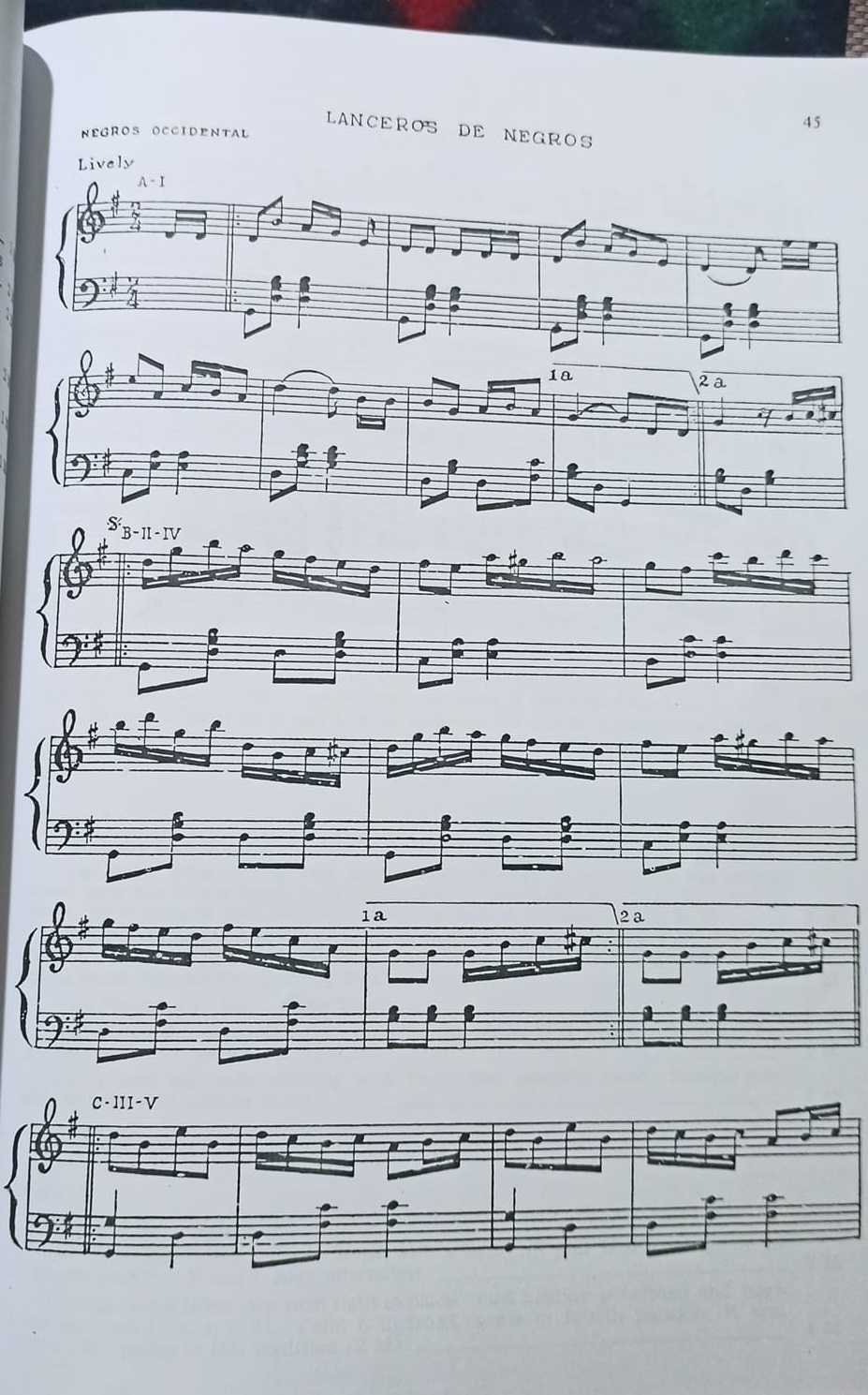
Folk Dance of Western Visayas Region: Lanceros de Negros


LANCEROS DE NEGROS

During the Spanish times, Lanceros was one of the most popular quadrille dances in the Philippines. It is similar to Rigodon and is danced in important social affairs to formally open a big ball. Unlike the Lanceros as danced in Luzon and in some regions in the Visayas, this version from Silay, Negros Occidental is in longways formation. It is a very lively and colorful dance. 

COSTUME. Girl wears Maria Clara style costume. Boy wears barong tagalog and black trousers. 

MUSIC is divided into four parts A, B, C, and Finale.

COUNT one, two; one, and two; or one, and two, and to a measure

FORMATION. Partners face each other about six feet apart. When facing audience, Girl is at right side of partner. Four to any number of pairs may participate. 

If desired, a square formation may be used, each pair occupying a corner of an imaginary square. 


NEW STEPS USED:

      Brincos Con Puntillas - Jump and land with R (L) foot across the L (R)  in front, both feet flat on the floor (ct. 1), hop on L (R) and foot circle outward in the air with R (L) foot (ct. and), step lightly on ball of R (L) foot in rear L (R) and raise heel of L (R) (ct. 2), spring on  R (L) and land on L (R) and at the same time point R (L) toe in front of L (R) with R (L) knee slightly bent (ct. and).

      Brincos Con Vueltas - Same as brincos con puntillas but make a quarter turn right (left) when hopping on L (R) on the first ct. and. Make another quarter turn right (left) before stepping on the ball of R (L) foot in rear of L (R) on ct. 2. There are two brincos con vueltas to a complete turn (2 M).


                                                                        I

Music A.

      Partners face each other. Throughout this figure, Girl's L hand is placed on waist, R hand holding skirt, Boy's arms swinging naturally down at sides.

     (a) Starting with R foot, take four small steps forward to meet at center (cts. 1, 2, 1, 2) ________________________ 2 M

     (b) Repeat (a) moving backward to proper places ________________________ 2 M

      Face left so that Girl's back is toward audience, Boy faces audience.

     (c) Repeat (a) and (b) _______________________ 4 M

      Face each other.

      (d) Starting with R foot, take four steps obliquely left forward, passing by R shoulders _______________________ 2 M

       (e) Repeat (d), moving obliquely right backward to proper places ________________ 2 M

        (f) Repeat (d), moving obliquely right forward, passing by L shoulders (2 M), and in (e) moving obliquely left backward. Take smaller steps backward so that partners finish near each other (2 M). _____________ 4 M


   II

Music B.

         Face partner and join R hands, free hand of Girl holding skirt and that of Boy is placed on waist.

         (a) Starting with R foot, take eight small change steps forward moving once around clockwise. Bend trunk slightly to right and left side alternately. ---------------------------------------------------- 8 M

         Drop R hands, turn right about join L hands free hands as above.
         (b) Repeat (a), moving counterclockwise -------------------8 M


 III

Music C.

       Partners face each other
       (a) Take four galop steps sideward right. Arms in lateral position, sideward left, shoulder level. Do not put weight on L foot at the fourth galop step _________________________________ 2 M
       (b) Repeat (a) moving to sideward left. Reverse position of arms. _____________________ 2 M
       (c) Execute four brincos con vueltas, turning right and making two turns. Girl holding skirt. Boy places hands on waist _____ 4 M
        Face left so that Girl's back is toward audience. Boy faces audience.
       (d) Repeat all (a-c). Partners pass front to front when doing the galop steps. _____________8 M


   IV

Music B.
      
     Partners face audience. Join inside hands, free hands as in figure II.
     (a) Starting with outside foot, take four change steps forward. Swing the joined hands backward and forward at the same time looking at partner and away from partner, alternately four times ______4 M

     Drop inside hands, turn outward to face about. Join inside hands, free hands as in (a). 
     (b) Repeat (a), starting with inside foot. Start swinging joined hands forward and looking away from partner.____________ 4 M
     
     Drop inside hands. Face each other and join R hands, free hands as in (a).
     (c) Starting with R foot, take four change steps forward, turning once around clockwise _____ 4 M

     Drop R hands, join L hands, free hands as in (a).
     (d) Repeat (c), moving counterclockwise. Drop L hands and finish in proper places _________ 4 M


 V

Music C.

       Partners face each other. Partners do their movements simultaneously.
       (a) Girl. Execute two brincos con vueltas making a complete turn right once (2 M)

            Boy. Clap hands five times on cts. 1, 2, 1, and 2______ 2 M
       (b) Repeat (a), Boy dancing and Girl clapping hands____ 2 M

       Partners face each other and assume crossed-arm position, R over L.

       (c) Take four brincos con puntillas moving toward audience - Jump and land with foot away from audience across in front and hopping on foot toward audience.  ______________________ 4 M

       Drop hands.
       (d) Repeat (a) and (b) __________________________________________________ 4 M
       (e) Repeat (c), starting with other foot and moving away from audience. __________________ 4 M


SALUDO
(Bowing)

Music Finale.

        Partner faces each other.
        (a) Pause_______________________________________1 M
        (b) Execute a three-step turn right in place (cts. 1, 2, 1), pause (ct. 2) Arms in fourth position, R arm high. __________________________________________________ 2 M
        (c) Repeat (b), turning left. Reverse position of arms. ________________________________ 2 M
        (d) Join R hands, free hand of Girl holding skirt, that of Boy is placed on waist. Girl whirls making right turns under the arch of arms. Boy stands in place. ___________________________________ 2 M
        (e) Face each other. In crossed-arm position, R over L, pull away from each other. __________ 1M
        (f) Girl passes under R arm of Boy and finish in front and a little bit to the left side of Boy. Partners look at each other. ___________________________________________________1 M


Music of Lanceros de Negros